Repair or Replace Your McCordsville Blinds: How to Decide
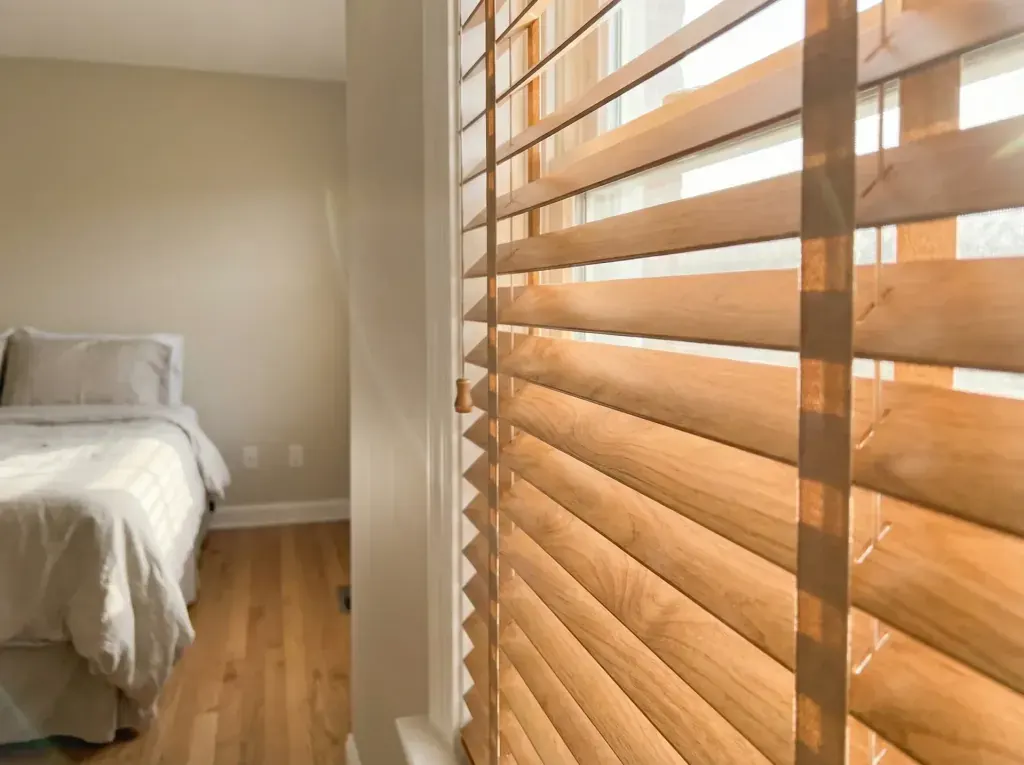
There's a version of a shade repair that works and a version that's finished, and homeowners can usually feel the difference without naming it. The bottom rail sits level. The light gaps match. The shade runs top to bottom with one hand. Here's the checklist behind that, on any McCordsville blind or shade.
Blinds and shades fail one part at a time
A window covering has more moving parts than people expect, and each can fail on its own. Cord locks, tilt gears, clutches, ladder strings, and lift cords all do separate jobs. A failure in one doesn't mean the others are compromised.
Describe exactly what's wrong instead of saying it's broken. Won't stay up, wand spins without effect, drifts down after you set it, one slat hangs crooked, those are four different repairs, not variations on one problem. We see this constantly across McCordsville homes: one part wears out years before the rest, and it all gets tossed if nobody looks closely first.
When repair beats replacement, and when it doesn't
Custom coverings measured and installed run roughly $250 to $2,600 a window nationally, stock runs roughly $60 to $600. A cord lock, gear, wand, or restring costs a fraction of either, and the rest of the unit still works. That's why repair is the default on one failed part, McCordsville build new or old.
- Fabric faded pale and brittle on the sun side. The right fabric slows fading, but nothing stops it. Once it tears at a fold, that's the end of it.
- A discontinued product line with no headrail parts left.
- Small children with older corded blinds around. ANSI/WCMA A100.1-2022 pushed this industry toward cordless for good reason.
- A unit that never fit the opening properly.
- A third repair call on the same blind.
Parts decide the rest. Cord locks, wands, gears, and lift cord fit a wide range. Clutches depend on tube diameter and load class. Motors are proprietary, a retired generation usually means a new tube. Dye lots matter too, a white from 2008 won't match one from two years back, so a marginal repair sometimes wins just to keep a room even. Conversion kits exist for some blinds, but a new stock cordless shade often beats the math once labor's added. Ordered parts typically take a few weeks to arrive.
Clutches and cordless lift systems
A clutch holds a roller or cellular shade wherever you leave it, releasing when you pull the chain. Worn, the chain slips and the shade creeps lower each cycle, or jumps the sprocket and locks up. Usual culprits: a shade heavier than its clutch class (a spec issue, not a flaw), or a chain tensioner never fastened to the wall.
Cordless shades lift on a spring motor instead, tensioned to counter the fabric's weight. That tension fades over years, and a shade that held perfectly starts drifting down. Calls for a tension reset or a new spring cartridge, not a replacement.
A silent motorized shade deserves a process. Battery first, a wand commonly runs about a year and hardly anyone in McCordsville tracks install date. Limits second, a motor stopping in the wrong place lost its range, not its motor. Pairing third, remotes lose their link after a power blip more than motors fail. Real failure means pulling the motor and resetting limits.
What a finished repair should look like
There's a checklist behind the word finished, repair or new install alike. Bottom rail level. Headrail level in its brackets, even on a slightly out-of-square opening, which is a conversation, not a hidden shim. Matching light gaps. Full travel, no stalling. One hand operation, or the spring tension, the clutch class, the mount, or the shade's size is wrong.
Plenty of what reads as a bad shade is really a bad install. A racked headrail between uneven brackets binds at one end no matter how new the mechanism is. A roller tube out of level walks fabric toward one side every cycle, which looks like drifting but is really a crooked tube. In McCordsville the fix is pulling the bracket and remounting it right, plus a short walkthrough on tilt travel and lift direction before anyone leaves.
A blind or shade that's acting up almost always has one specific cause, and naming it correctly is most of the job. McCordsville Window Treatments has spent years sorting cord locks from clutches from motors in McCordsville homes, and we'll tell you honestly when a part is worth replacing and when the whole unit is. We're insured and bonded. Call (317) 999-5154 to get it looked at.
Cords and tilt mechanisms
The cord and ladder system takes the most wear on a horizontal blind, friction at the lock and at every slat hole. A blind that won't hang level or a cord gone fuzzy and swollen are the early signs. A slat dropped lower than the rest is different, a snapped rung, not a worn cord. Once the cord parts, the blind stops raising. Restringing rebuilds the run, new ladder string included on wood blinds.
The cord lock, a toothed pin in the headrail, clamps the cord to hold height. Worn, or fed a fattened cord that won't seat, and the blind drifts down alone, or occasionally won't release at all. Either way, a new lock swaps in fast.
A worm gear turns the tilt rod, driven by the wand. Crank it past the slats' closed point long enough and the nylon teeth shear off, leaving a wand that spins freely and moves nothing, the single most common tilt failure we see across McCordsville. New gear, new rod if needed, new wand if the hook's snapped.
Frequently Asked Questions
My roller shade fabric keeps drifting toward one side. Is it broken?
Probably not. That's called telescoping, and it almost always means the tube isn't level. A roller tube that tilts even slightly walks the fabric a little further toward the low end on every cycle until it rubs a bracket. The fix is taking the brackets off and remounting them level, then re-rolling the fabric square onto the tube. Occasionally the fabric was rolled on crooked at the factory, which is a warranty conversation rather than a repair.
How can I tell whether an install was done properly?
Look at four things. The bottom rail should sit level to your eye, the light gaps on the left and right should match, the shade should travel fully in both directions without stalling, and adjacent windows in the same room should line up with each other. Then check the details: chain tensioners fastened to the wall, hold-down brackets on any door-mounted blind, valance returns installed, and no pencil marks left on the trim.
My cordless shade used to hold its height and now it drifts down. What's wrong?
That's a relaxed spring, not a broken shade. Cordless shades lift on a spring motor built into the headrail, tensioned to balance the weight of the fabric so a light touch raises or lowers it. Years of daily use ease that tension, and the shade starts sinking a little after you set it. A tension adjustment fixes it in most cases, and a spring cartridge swap handles it when adjustment alone isn't enough. It isn't a sign the shade needs to be replaced.
 DIY Window Measuring: A Straight Answer on the Risk
 Cellular Shades and R-Value: What the Numbers Mean for McCordsville Homes
 Measuring Wood Blinds Right in a McCordsville Home