Cellular Shades and R-Value: What the Numbers Mean for McCordsville Homes
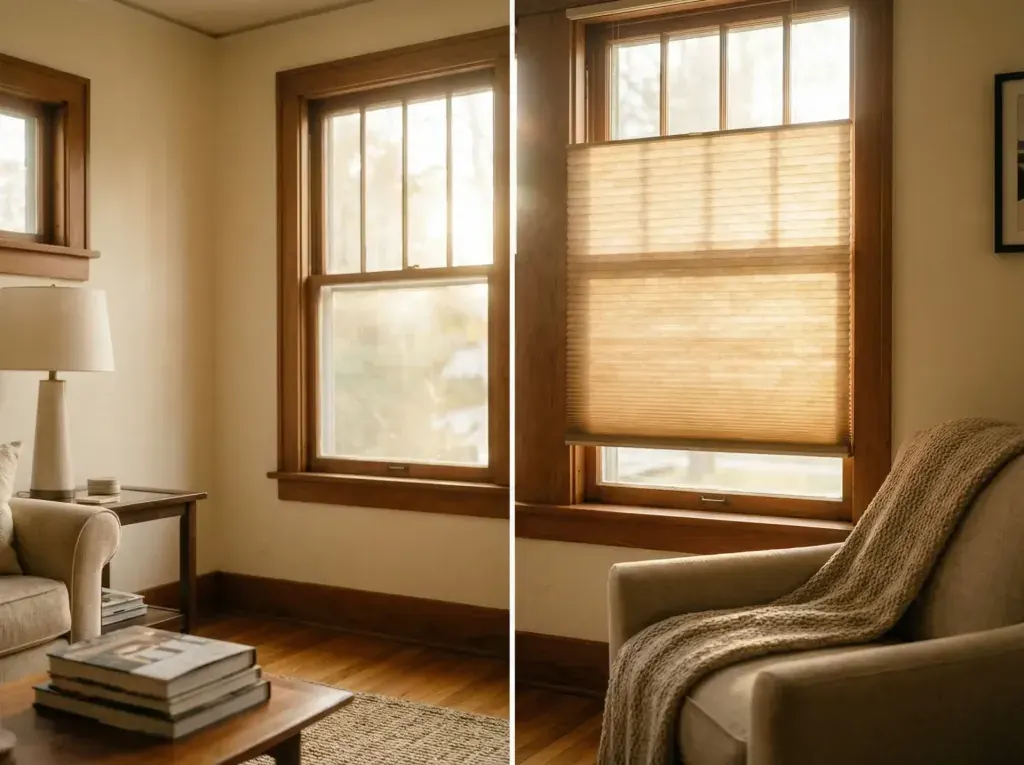
Some rooms in a house are just colder than others, and the window facing that room usually has more to do with it than the thermostat setting does.
Why Older Windows Feel Colder Than the Thermostat Says
Walk into a room in McCordsville with the furnace running and the thermostat reading 70, then stand a foot from the glass. It's colder there. Not because the air is different, but because your body is losing heat to that cold pane through radiation, the same way you feel a chill standing near a walk-in cooler door even with it shut. Glass surface temperature on a January night can sit 20 or 30 degrees below the room's air temperature, and your skin responds to that difference whether or not a single molecule of outside air ever gets in.
There's a second effect stacked on top of it. The air touching that cold glass cools, gets denser, and sinks, rolling down the pane and spilling out across the floor in front of the window. People call this a draft, and it feels exactly like one, but it can happen even on a window with a tight, well-sealed frame. Older double-hung windows common in a lot of McCordsville neighborhoods make this worse, since the glass itself is often single-pane or early double-pane with a lower insulating value than anything sold today.
Knowing which of these is happening in a given room matters, because a shade or drapery panel addresses the radiant and convective chill directly. It does very little for an actual air leak around a bad seal, which is a separate repair entirely.
Layering Shades and Drapery for the Coldest Rooms
Plenty of McCordsville homeowners already do a version of this without thinking about it: sheers for summer, heavier panels that come out for winter. Formalizing that into a real layered setup, a cellular shade underneath with lined drapery over it, does more for a genuinely cold room than either piece alone, especially in a room people actually sit in during the evening, like a living room with a big west-facing window or a primary bedroom.
The drapery needs to close all the way over the opening at night to do anything useful. A narrow panel that only covers the middle of the window and leaves both sides of the glass exposed looks nice folded open but isn't doing much when it matters most.
What Window Treatments Can and Can't Fix
It's worth saying plainly: no shade or drapery, at any price, replaces a window with a genuinely failed seal or a warped frame. Weatherstripping and air sealing are a separate, usually less expensive project, and doing that first on the worst offenders sometimes changes what a room actually needs from its treatments afterward.
Full window replacement sits at the far end of the cost range and solves the glass problem directly, but it's a much bigger investment than treatments and not always necessary right away. For a lot of McCordsville homes, a combination, minor air sealing where it's cheap to do, then treatments sized to the room, covers the comfort problem without the largest expense on the list. It's worth pricing that combination out before jumping straight to the most expensive option on paper.
If a room in your house never quite feels as warm as the thermostat claims, a free in-home measure is a straightforward way to find out whether the fix is a shade, a layered setup, or something with the window itself.
How Cellular Shades Trap Air Instead of Just Blocking Light
A cellular shade isn't magic, and nobody should be sold on one like it is. It's pleated fabric folded into small hexagonal pockets that trap still air, and still air is a lousy heat conductor, so the shade slows the rate at which the room's warmth gets pulled toward the cold glass. That's the entire mechanism. No special coating, no hidden technology.
Cells run from about 3/8 inch to a full inch depending on the line, single-row or double-row. Manufacturers publish R-values for the fabric itself, typically R-1.5 to R-2 for single-cell and R-3 to R-3.5 for double-cell. Those numbers describe a few inches of shade, not the whole window assembly, and nobody should expect them to rewrite a heating bill on their own.
Mount Style and Fit Change How Much Draft Gets Through
The R-value on a spec sheet assumes a shade fitted tight to its opening, and a loose or poorly measured install gives up a lot of that number. Inside mount depends on accurate depth measurements, generally 2.5 to 3 inches minimum for a standard headrail, and a shade ordered even a quarter inch too narrow leaves visible gaps down both sides where the insulating cells stop doing anything useful.
Outside mount avoids that measurement risk because the shade overlaps the frame instead of fitting inside it, typically extending 2 to 3 inches beyond the opening on each side and at the top. On drafty or out-of-square older frames, that overlap matters more than the shade's own R-value, since it's covering the leakiest part of the assembly rather than just the glass. Side channels close the remaining vertical gap on either mount style and are worth the upcharge on a room that's noticeably cold.
Frequently Asked Questions
What R-value should I expect from a cellular shade?
Manufacturers typically publish figures around R-1.5 to R-2 for single-cell fabric and R-3 to R-3.5 for double-cell. That's the insulating value of the shade itself, added to whatever the window already provides. It's not a promise about a specific change in a heating bill, just a description of how the product is built.
Does drapery over a shade actually help, or is it mostly decorative?
Both, but the functional part is real. A lined panel adds another layer of still air between the room and the window, and it only helps with comfort if it actually closes over the full opening at night. A narrow panel that stays open most of the way isn't doing much beyond looking good.
Are side channels on cellular shades worth the extra cost?
On a room that's noticeably cold, generally yes. They close the gap along the sides of the shade where it would otherwise leave the edge of the glass exposed. On a room that's already comfortable, they're a smaller priority and easier to skip.
 DIY Window Measuring: A Straight Answer on the Risk
 Measuring Wood Blinds Right in a McCordsville Home
 Retractable Awning Mistakes McCordsville Homeowners Make